Friday, August 25, 2006

Perspectives

What are perspectives?

Sense from:
Zen Keys
Thich Nhat Hanh, Philip Kapleau
Page 10
Image
ISBN: 03854-75611

What is a tree?

  • A philosopher might call it ultimate truth.
  • A botanist, a living organism.
  • A physicist, a mass of protons and neutrons swirling around a nucleus.
  • An artist, a unique shape with distinctive colouring.
  • A carpenter, a potential table.
  • To a dog, however, it is nothing but a urinal.

All descriptions, explanations or analyses are but a looking from one side at that which has infinite dimensions. The true nature of the tree is more than anything that can be said about it.

Wednesday, August 23, 2006

Meaningfull Life

Did I live meaningfully?

Sense from:
Whistle while you work
Richard Leider, David Shapiro
Page 78
Berrett-Koehler
ISBN: 1-57675-103-1

Elizabeth Kubler-Ross, arguably the world’s expert on people’s attitudes about death and dying, summarized a life of research in three simple questions. When people look back upon their lives, she found, they ask three questions that determine their sense of whether it was meaningful:

  1. Did I give and receive love?
  2. Did I become all I can be?
  3. Did I leave the planet a little better?

Tuesday, August 22, 2006

Experiential Learning Cycle

How do we learn from experience?

Source:
Roles of volunteer in development
Peace Corps
Page 31 – 33


The process of learning is a process of acquiring knowledge, skills, and attitudes so that we can solve problems and make changes in our lives as we move toward fulfilling our needs and our goals. This learning process can be conceived as a four-step cycle.
  1. We experience something.
  2. We review the experience critically.
  3. We draw a conclusion and / or infer useful insights ( lessons learned ).
  4. We apply or try out our new insights or hypotheses in a new situation ( which leads to another experience and so on ).
This natural process is called “experiential learning” and we use it all the time although we may not be completely conscious of the four steps. In many structured adult learning situations, we try to design most of the activities to follow the experiential learning cycle. Here’s what the cycle looks like in a training context:

Experiential Learning Cycle
 

Experience
The “experience” that activates the experiential learning cycle may be an event from your past, an activity you conducting or a case study you read and analyze. In this step, you do something or remember something you did in the past. It usually involves uncovering new information that requires a response from you.

Reflection
Reflection is a way of exploring and sorting out what happened during the experience stage. What new information do you now have and what does it mean? What feelings has it provoked in you? How might you relate the experience to things you already know? If you are participating in a group activity, how is your learning experience similar to or different from that of others?

Drawing conclusions and lessons learned
After reflecting on the experience, we arrive at the critical stage of determining what lessons can be learned or what principles can be drawn from the experience. This is the “so what” stage. How does all of this fit together? What are the major themes or insights you can infer from your experience?

Planning and application
Planning and application is the stage where you relate the learning to your world and actually start using the information. It’s called the “now what” stage. What will you do differently now that you have learned these lessons? How will this new insight help you improve your technical ability, your interactions with the community, or your collaboration with your Counterparts? As you apply what you have learned, you generate new experiences and the “experiential learning cycle” starts all over again!

All four of these stages are important for a rich and complete learning experience. Sometimes, we jump too quickly from experience to experience and shortchange the other three steps in the learning cycle. It is important to be as conscious as possible of your own experiential learning processes and take the time to really reflect, draw conclusions, and apply lessons learned before moving to the next experience.

Friday, August 18, 2006

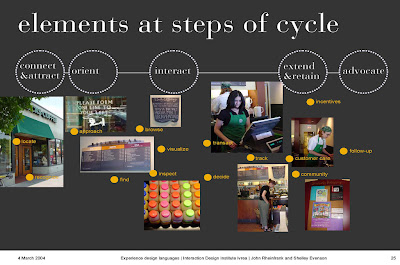
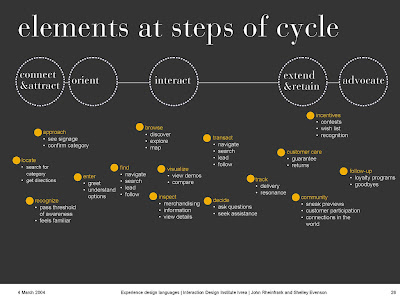
Starbucks customer journey

Source:
Experience design languages
John Rheinfrank and Shelley Evenson
Interaction Design Institute Ivrea

Wednesday, August 16, 2006

Happiness

What make us happy?
Money, good looks, intelligence or youth doesn’t bring us happiness. Narcissism and sense of humor do.

How to make us happy?
  1. Develop good social skills
  2. Volunteer
  3. Get married or at least cohabitate
  4. Purse meaningfull goals and take pleasure in the process
  5. Enjoy little things
Sense from:
Psychology Today 2005 Jan
Kathleen McGowan
Pg 52 - 53
ISSN: 0033-3107

Tuesday, August 15, 2006

Interest Expedition

Question
How can I learn in the most effective way?
 
Possible Answer
Follow your interest
 
Sense from:
Information Anxiety 2
Richard Saul Wurman, Loring Leifer, David Sume
Que
Page 87
ISBN: 0-7897-2410-3
 
You can follow any interest on a path through all knowledge. Interest connections form the singular path to learning. It doesn’t matter what path you choose or where you begin your journey. A person can be interested in horses or the concept of time and can make connections to other bodies of information.


Someone who’s interested in cars could move into a fascination with the Porsche and the German Language or the physics of motion or the growth of cities and the pattern of movement and defense or the chemistry of fuels. Various cars are made by various countries that have different languages and histories. Studying Italian automotive design, you can gain entry into the study of roads, the Appian Way, the plan of and the history of transportation itself.

The idea that you can expand one interest into a variety of other interests makes your choices less threatening. You can jump into a subject at any level and not only can you follow the subject to greater levels of complexity but you can follow it to other subjects.

Tuesday, August 8, 2006

Chris Anderson's views on innovation

What are Chris Anderson's views on innovation?
  1. Do not hire for fit. Hire misfit. Look for connections between fit and misfit.
  2. Do not hire for deep knowledge, hire for broad knowledge.
  3. Innovation and value are going to be found in the synthesizers - the people who draw together stuff from multiple fields and use that to create an understanding of what the company should do.
  4. Businesses that don't offer meaning to their employees will not succeed in the long term.
Sense from:
Finding Ideas
Harvard Business Review 2002 Nov
Chris Anderson, Bronwyn Fryer
Page 18-19
ISSN: 00178012